Hair follicles are often explained as structures, but that description only goes so far. In reality, they behave more like active biological systems. They don’t stay the same, they shift, respond, and adjust over time. What we notice on the surface, whether it’s growth, thinning, or shedding, is just the outcome. The real activity sits underneath, shaped by how structure, signalling, and the hair cycle interact with each other.
None of these operate in isolation. That’s important. So instead of thinking of the follicle as a fixed root, it makes more sense to see it as a mini-organ something that keeps evolving. That shift in perspective is also why modern hair science treats follicle biology as a core framework. It helps explain not just how hair grows, but why it changes over time. At the centre of this are three connected elements: follicle structure, the stem cell niche and microenvironment, and the hair growth cycle. They don’t work separately. Together, they shape how follicles function and renew.
Understanding Hair Follicle Structure
The hair follicle sits below the skin, but its role goes beyond producing hair that we can see. It works as a coordinated unit. Different structures interact constantly, supporting growth, signalling, and regeneration. Each component plays a role, but looking at them individually only gives part of the picture. It starts to make more sense when viewed in context biologically and clinically.
Hair Bulb: Where Growth Begins
Definition: The hair bulb is the base of the follicle where hair formation starts.
Biological Role: It contains the cells responsible for producing the hair shaft and initiating growth activity.
Clinical Relevance: Because it marks the starting point of follicular activity, the bulb helps explain how growth begins and continues under normal conditions.
Dermal Papilla: The Regulatory Centre
Definition: A specialised structure within the hair bulb composed of signalling cells.
Biological Role: It regulates follicular behaviour through molecular signalling, influencing growth, differentiation, and cycling.
Clinical Relevance: In current research, the dermal papilla is often treated as a regulator of follicular activity. That’s why it sits at the centre of discussions around hair growth dynamics and regenerative biology.
Matrix Cells and Hair Shaft Formation
Definition: Rapidly dividing cells surrounding the dermal papilla.
Biological Role: They generate the hair shaft and support continuous growth during active phases.
Clinical Relevance: Their activity gives an indication of how effectively the follicle is functioning during growth.
Bulge Region: Stem Cell Reservoir
Definition: A region of the follicle that houses stem cells.
Biological Role: It supports regeneration, renewal, and long-term follicular maintenance.
Clinical Relevance: The bulge plays a role in how follicles sustain themselves across repeated cycles.
Inner and Outer Root Sheath
Definition: Structural layers surrounding the follicle.
Biological Role: They provide support, protection, and organisation for the growing hair.
Clinical Relevance: These layers help maintain the stability of the follicle so that different components can work together.
The Stem Cell Niche and Follicular Microenvironment
Hair follicles don’t operate on their own. What surrounds them matters just as much.
There’s signalling, structural support, and biological interaction happening all at once. These don’t act separately; they form a connected system. That system influences how follicles grow, respond, and adapt.
Understanding the Stem Cell Niche
The stem cell niche, mainly located in the bulge region, is often described as a specific area. But in practice, it behaves more like a control system. These stem cells are not constantly active. They respond when triggered by certain biological signals. That’s what allows the follicle to re-enter growth phases.
This pattern repeats. Growth isn’t a one-time event; it happens in cycles. Because of this, the stem cell niche is closely tied to long-term follicular behaviour. It reflects how well the follicle can maintain itself and adapt over time. In research, it’s not just seen as a structure. It’s treated as a driver of regeneration.
The Follicular Microenvironment as a System
The follicular microenvironment works best when viewed as a system:
- Signalling pathways regulate communication between follicular cells
- Vascular supply delivers oxygen and nutrients required for activity
- Extracellular matrix provides structural and biochemical support
- Immune interactions help maintain balance within the follicle
All of these work together. That’s what allows the follicle to function properly.
If one part shifts, the overall behaviour can change. This is why the microenvironment is studied as a whole.
Hair Growth Cycle Phases Explained
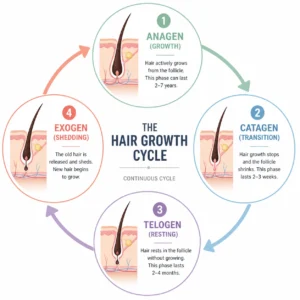
Hair growth doesn’t follow a straight path. It moves in cycles. At any given time, different follicles are in different stages. That’s normal. It’s what creates the overall pattern of hair growth. What matters more is the movement between these stages. The follicle is always progressing; it doesn’t stay still. This ongoing rhythm supports renewal over time.
Anagen: Active Growth Phase
The cycle begins with anagen. This is where the follicle actively produces hair. Matrix cells divide rapidly under signals from the dermal papilla, leading to visible growth. This phase can last for years and plays a role in determining hair density and length.
Catagen: Transition Phase
As anagen ends, the follicle doesn’t stop suddenly. It moves into a short transition phase. Growth slows, and the follicle begins controlled regression before entering the next stage.
Telogen: Resting Phase
After catagen, the follicle enters telogen. It’s often described as resting, but the cycle continues in the background. The follicle maintains its structure and prepares for the next growth phase.
Exogen: Shedding Phase
During this stage, the follicle releases the existing hair.This shedding is part of the cycle. It allows the follicle to reset and begin again.
Cycle Continuity and Clinical Relevance
These phases don’t function independently. They form a loop. The follicle is always cycling growth, transition, rest, and back again. When this stays balanced, renewal continues. When it shifts, visible changes may appear. That’s why disruption in the hair growth cycle is central to understanding hair loss and alopecia.
How Hair Follicle Biology Relates to Hair Loss and Alopecia
Understanding hair follicle biology helps provide context to processes linked to hair loss and alopecia. Researchers study how changes in signalling, stem cell activity, the microenvironment, and cycling may influence follicular behaviour. This understanding builds over time.
Dermal Papilla Signalling
Changes in dermal papilla signalling are often looked at when trying to make sense of shifts in follicle behaviour. It’s not just about signals being sent, it’s how those signals are interpreted at different points in the cycle. Sometimes the change is subtle. Not dramatic, not immediate. But over time, it can influence how the follicle responds. That’s one of the reasons this region keeps coming up in research conversations.
Stem Cell Dysfunction
The stem cell niche sits quietly in the background, but it plays a role that shows up over time. It’s not always obvious at the moment. When something affects how these cells activate or regenerate, the impact tends to build gradually across cycles rather than all at once. That long-term influence is why stem cell biology is so often part of discussions around hair loss and alopecia.
Microenvironment Imbalance
The surrounding microenvironment is not just one thing, it’s a mix. Signalling, blood supply, immune balance… all working alongside each other. When that balance holds, things tend to function as expected. When it shifts even slightly the effect can ripple through the follicle. Not always immediately, but enough to matter. That’s why researchers usually look at it as a system, not separate pieces.
Hair Cycle Disruption
Hair growth follows a cycle, but more than that, it follows a rhythm. When that rhythm changes timing, duration, how one phase moves into the next it can alter how the follicle behaves over time. It’s rarely about a single phase in isolation. Which is why, in practice, cycle disruption stays central to how hair behaviour is studied.
Conclusion
The hair follicle is not a single structure but an integrated biological system where structure, stem cell niche, microenvironment, and cycle work together. Modern hair science increasingly studies these elements not in isolation, but as interconnected processes that collectively determine follicular behaviour over time.
This shift from understanding individual components to viewing the follicle as a coordinated system is what drives deeper insight into hair growth, renewal, and the biological processes associated with hair loss and alopecia. As research evolves, it is this integrated perspective that continues to shape how follicular biology is studied and understood.
FAQs
What is the role of the dermal papilla in hair growth?
The dermal papilla acts as a signalling centre that helps regulate follicle activity and supports biological processes involved in hair growth and cycling.
What is the hair follicle stem cell niche?
The hair follicle stem cell niche is the specialised environment in the bulge region where stem cells are maintained and contribute to follicular renewal.
What are the main hair cycle phases?
The main hair cycle phases are anagen (growth), catagen (transition), telogen (resting) and exogen (shedding).
How does the follicular microenvironment affect hair growth?
The follicular microenvironment influences follicle behaviour through signalling pathways, blood supply, cellular interactions and immune regulation.
How does hair follicle biology relate to hair loss and alopecia?
Understanding hair follicle biology helps explain how changes in signalling, stem cell activity, microenvironment balance and cycle regulation may relate to hair loss and alopecia.
Can damaged hair follicles regenerate?
Research into regrowth of hair follicles continues to evolve, with scientific interest focused on regenerative biology, stem cells and follicular signalling.